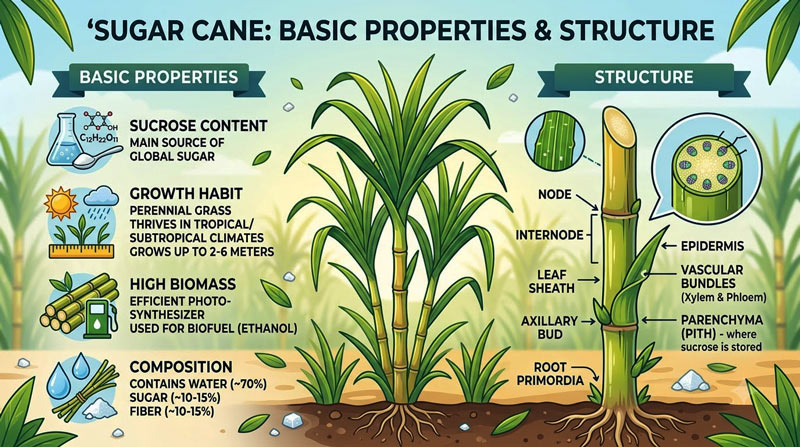
Sucrose or Sugar: The chemical name of sugar used in food is sucrose. It is also known as Cane sugar. It is mainly found in sugar cane.
Hence it is also called cane sugar. It is also found in sugar beet and some other fruit vegetables.Manufacturing Process – SucroseSugarcane is the major source of sucrose in India. Following is the term used in the industrial manufacture of sucrose or sugar from sugarcane.Extraction of the juiceFirstly sugarcane juice is extracted using a roller mill. After this, with the help of other techniques, the maximum amount of sucrose in the residue is extracted as juice.Purification of the JuiceThere is 15 25% sucrose from the juice obtained from the above post. In this, organic and inorganic acids are present as proteins and other compound impurities. Following are the major terms used in its refinement.Defection: By mixing 2 3% solution of lime in sugarcane juice, the ph value of the solution is reduced to about 7. The solution is heated by stream coils.In doing so, all organic and most inorganic acids precipitate as their calcium salts, and most proteins and other compounds also dissociate as precipitates due to coagulation. Filter them and separate them.Glucose | Fructose || DisaccharidesStructure of Diasaccharides eg. Sucrose, Maltose, Lactose Structure of Polysaccharides eg. Starch, CelluloseSucrose or Sugar: The chemical name of sugar used in food is sucrose. It is also known as Cane sugar. It is mainly found in sugar cane.
Hence it is also called cane sugar. It is also found in sugar beet and some other fruit vegetables.Manufacturing Process – SucroseSugarcane is the major source of sucrose in India. Following is the term used in the industrial manufacture of sucrose or sugar from sugarcane.Extraction of the juiceFirstly sugarcane juice is extracted using a roller mill. After this, with the help of other techniques, the maximum amount of sucrose in the residue is extracted as juice.Purification of the JuiceThere is 15 25% sucrose from the juice obtained from the above post. In this, organic and inorganic acids are present as proteins and other compound impurities. Following are the major terms used in its refinement.Defection: By mixing 2 3% solution of lime in sugarcane juice, the ph value of the solution is reduced to about 7. The solution is heated by stream coils.In doing so, all organic and most inorganic acids precipitate as their calcium salts, and most proteins and other compounds also dissociate as precipitates due to coagulation. Filter them and separate them.Glucose | Fructose || DisaccharidesStructure of Diasaccharides eg. Sucrose, Maltose, Lactose Structure of Polysaccharides eg. Starch, Cellulose.
Carbonation: Carbon di-oxide gas flows in the solution obtained from the above term. By doing this, the excess of lime dissociates as precipitates of calcium carbonate.
Decolourisation: The solution obtained from the above term is thick brown. When it flows over the layers of adsorbents such as animal charcoal, it becomes discolored, the colored material is absorbed by the adsorbents and the colorless fluid is obtained.
Sulfuric Acid : Chemical Properties, Uses and Structure
Rigid Body: Moment of Force or Torque formula
Preparation of Sulphuric Acid by Contact process with Reaction
Preparation of Sulfuric Acid by Lead Chamber Process
Ozone: Tests, Uses and Ozone Structure
What is Ozone Gas in the air? Ozone Gas Properties.
Chemical Properties of Hydrogen Peroxide
What is Deuterium or Heavy Water? How to make Deuterium?
Carbonation and decolourisation used in refining in India are done simultaneously. For this, sulfure dioxide flows in the solution obtained by defecation. This action is called sulphitation. In this process, impurities of acids are precipitated as their sulphate, coagulation of protien and other substances occurs and decolourisation of the solution also occurs due to the bleaching action of sulfur dioxide.
Concentration and Crystallisation: After the treatment of sugarcane juice, it is heated at low pressure. Multiple effect evaporators are used for this. In these evaporators pure juice is heated by stream coils. Separately prepared water vapor flows into the coils of the first evaporator.The vapors from the first evaporator flow into the coils of the second evaporator, the vapors from the second evaporator into the coils of the third evaporator and likewise to the coils of the other evaporators.Under the influence of low pressure, the action of evaporation takes place intensely. Crystals of sucrose or sugar are obtained by cooling the concentrated fluid.
Separation and drying of crystals: From the mixture of liquids and cristals obtained from the above term, the liquid crystals are separated by centrifugal machines. The cristals are dried under the influence of hot air. The remaining fluid i.e. mother liquor is called molasses. In India, alcohol is the main raw material of the industry.
Physical PropertiesSucrose or Sugar is a colorless odorless and crystal solid. Its melting point is 185°C. It tastes sweet. It is very soluble in water but very soluble in alcohol. It is optically active. And dextro is rotatory. It has a specific dextro rotatory + 66 and does not exhibit variable mutarotation.
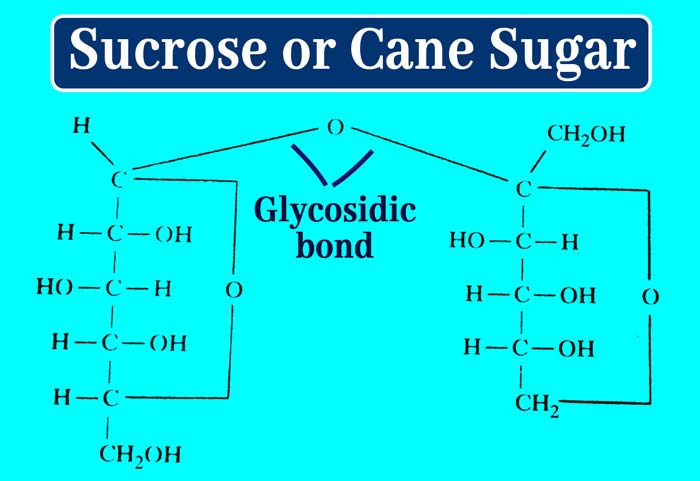
Chemical PropertiesThe molecule of sucrose is formula C12H22O11. Its structure formula is the following.It is clear that a molecule of glucose in a molecule of sucrose is bound to a molecule of fructose between the hemiacetal group. This bond is called glycosidic bond.
Read more about Glycosidic Bong