Chemical Formula
- Copper pyrites – CuFeS2
- Silver Sulphide – Ag2S
- Lead Sulphide – PbS
- Hematite – Fe2O3
- Silicon Dioxide – SiO2
- Magnesium Carbonate – MaCO3
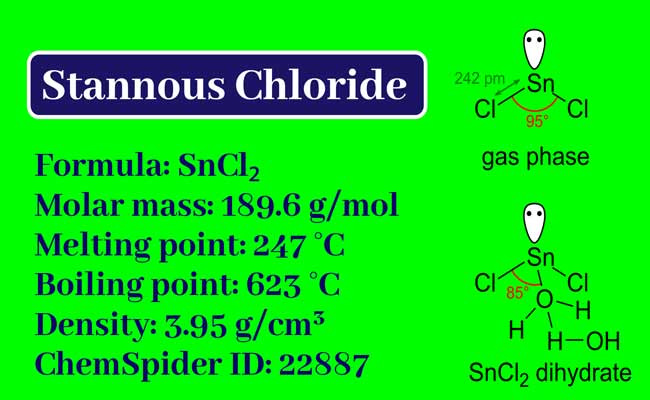
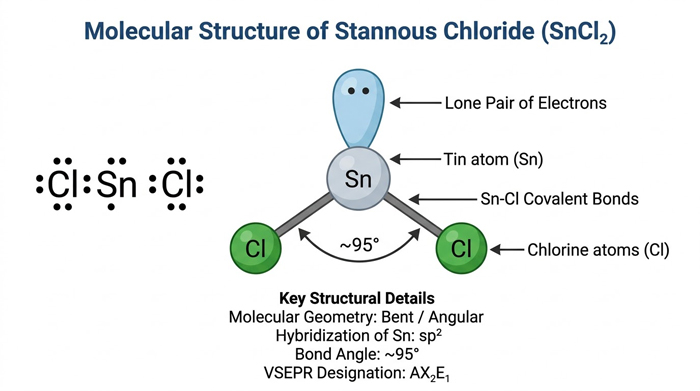
Preparation of Stannous Chloride
Anhydrous stannous chloride is obtained when the dry hydrochloride acid gas flows in the hot tin.
Sn (s) + 2HCl (aq) → SnCl2 (aq) + H2 (g)
Stannous chloride is obtained by heating the tin with mercuric chloride.
Sn + HgCl2 → Hg + SnCl2
Anhydrous stannous chloride cannot be obtained by heating the hydrous stannous chloride(SnCl2.2H2O), as tin oxidechloride is formed upon heating.
SnCl2.2H2O → HCl + Sn(OH)Cl + H2O
Crystals of stannous chloride are obtained by evaporating the solution obtained by heating the tin with concentrated hydrochloride acid.
Sn + 2HCl + 2H2O → SnCl2.2H2O + H2
Stannous chloride solution is also obtained by heating stannous oxide or stannous hydroxide with concentrated hydrochloric acid. Crystals are obtained by evaporation.
SnO + 2HCl + H2O → SnCl2.2H2O
Sn(OH)2 + 2HCl → SnCl2.2H2O
Physical Properties
| Property | Description |
|---|---|
| Chemical Name | Basic Lead Acetate / Lead Subacetate |
| Chemical Formula | Pb(CH₃COO)₂ · 2Pb(OH)₂ (approximate) |
| Molar Mass | Variable (mixture of lead acetate and lead hydroxide) |
| Appearance | White to slightly yellowish powder or crystalline solid |
| Odor | Mild acetic acid odor |
| Physical State | Solid at room temperature |
| Melting Point | Decomposes on heating (~200°C) |
| Boiling Point | Not applicable (decomposes) |
| Density | ~2.5–3.0 g/cm³ (varies with composition) |
| Solubility in Water | Slightly soluble; forms a cloudy solution |
| Solubility in Other Solvents | Soluble in acetic acid; insoluble in ethanol |
| Crystal Structure | Amorphous to microcrystalline |
| Hygroscopic Nature | Mildly hygroscopic |
| Magnetic Susceptibility | Diamagnetic |
| Toxicity | Highly toxic (lead poisoning risk) |
Chemical Properties
Reaction with water: It hydrolysed in excess of water to form tin oxychloride.
SnCl2 (aq) + H2O (l) ⇌ Sn(OH)Cl (s) + HCl (aq)
Reaction with marcuric chloride: Hg2Cl2 is first formed by adding marcuric chloride solution to the stannous chloride solution, which is reduced by the addition of stannous chloride to Hg.
SnCl2 + 2HgCl2 → SnCl4 + Hg2Cl2
Hg2Cl2 + SnCl2 → SnCl4 + 2Hg
Reaction with ferric chloride: It reduces the ferric chloride to ferrous chloride.
2FeCl3 + SnCl2 → 2FeCl2 + SnCl3
Reaction with iodine: In the presence of HCl acid, it also reduces iodine.
I2 + 2HCl + SnCl2 → SnCl4 + 2HI
Reaction with NaOH: It reacts with NaOH to form stannous hydroxide precipitates which dissolve in excess of NaOH and dissolve sodium.
SnCl2 + 4NaOH → 2NaCl + 2H2O + Na2SnO2
Reaction with H2S gas: Black precipitate of stannous sulfide is obtained when hydrogen sulfide gas flows in the stannous chloride solution, which dissolves in the yellow ammonium sulfide solution.
SnCl2 + H2S → 2HCl + SnS
SnS + (NH4)2S2 → (NH4)2SnS3
Reduction: Tin metal is obtained by heating SnCl2 with Zn.
SnCl2 + Zn → ZnCl2 + Sn
Uses of Stannous Chloride
1. In Qualitative Analysis (Salt Analysis)
Test for Mercury (Hg²⁺): Reduces mercuric chloride to white mercurous chloride (calomel) and then to black metallic mercury.
Test for Gold (Au³⁺): Reduces gold salts to purple colloidal gold (Cassius purple).
Test for Silver (Ag⁺): Reduces silver salts to metallic silver.
Test for Arsenic (As³⁺): Used in Marsh’s test for arsenic detection.
2. As a Reducing Agent
Reduces Fe³⁺ to Fe²⁺ in redox titrations.
Reduces nitro compounds to amines in organic synthesis.
Used in the reduction of dyes and bleaching agents.
3. In Electroplating
Used in tin plating and electroless plating of metals.
Acts as a sensitizer in the activation of non-conductive surfaces before electroplating.
4. In Organic Chemistry
Acts as a catalyst in esterification and polymerization reactions.
Used in the preparation of organotin compounds (e.g., stabilizers for PVC).
5. In Dyeing and Textile Industry
Used as a mordant in dyeing fabrics.
Acts as a reducing agent in vat dyeing.
6. In Food and Beverage Industry
Used as a preservative and antioxidant in canned foods and soft drinks (limited use due to toxicity concerns).
7. In Photography
Used in toning solutions for black-and-white photography.
8. In Analytical Chemistry
Used in iodometric titrations and colorimetric analysis.
Basic Lead Acetate [Pb(OH)2.Pb(CH3COO)2]
In the presence of air, Basic lead acetate is obtained by the reaction of lead and acetic acid.
2Pb + 2CH3COOH + O2 → Pb(OH)2.Pb(CH3COO)2
In the presence of air, Basic lead acetate is obtained by the reaction of lead and acetic acid.
2PbO + 2CH3COOH → Pb(OH)2.Pb(CH3COO)2
2PbCO3 + 2CH3COOH → Pb(OH)2.Pb(CH3COO)2 + 2CO2
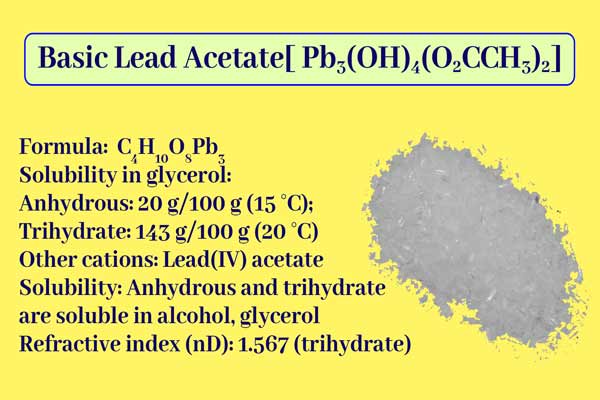
Basic Lead Acetate Properties
Basic lead acetate, also known as lead subacetate, is a white crystalline powder or solid with the approximate formula Pb₃(OH)₄(O₂CCH₃)₂ or Pb(CH₃COO)₂·2Pb(OH)₂ and a molar mass of about 807.7 g/mol (though values vary due to its variable composition).
It has a density of 1.33 g/cm³ (or 3.58 g/cm³ at 22°C depending on the specification) and decomposes at 198–205°C rather than melting sharply. It is only slightly soluble in water (about 6.3 g/100g at 0°C), but readily soluble in dilute acetic acid, dilute nitric acid, and ethanol.
Its aqueous solution is strongly alkaline with a pH of about 7.2 (50 g/L at 20°C) and rapidly absorbs atmospheric carbon dioxide, forming a cloudy precipitate of lead carbonate. It should be stored below 30°C in a sealed container protected from moisture.
Importantly, basic lead acetate is not a single pure compound but a mixture or complex of lead acetate and lead oxide/hydroxide (CAS numbers 1335-32-6 and 51404-69-4), and it is highly toxic, posing a serious risk of cumulative lead poisoning, so it must be handled with strict safety precautions and disposed of as hazardous waste.
3[Pb(OH)2.Pb(CH3COO)2] + 4CO2 + 2H2O → 2[2PbCO3.Pb(OH)2] + 6CH3COOH
Basic Lead Acetate Properties
In Organic Chemistry
Precipitating Agent: Used to precipitate proteins, alkaloids, and other organic compounds.
Clarifying Agent: Helps remove impurities from organic solutions.
Catalyst: Acts as a catalyst in certain organic reactions.
Detection of Sugars: Used in sugar analysis and detection of reducing sugars.
In Sugar Refining
Decolorizing Agent: Removes colored impurities from sugar solutions.
Clarifying Agent: Precipitates suspended impurities, producing clear sugar solutions.
Purification: Used in the refining of cane sugar and beet sugar.
In Medicine (Historical Use)
Astringent: Used in eye lotions and skin preparations to reduce inflammation.
Antiseptic: Applied as a topical antiseptic for wounds and bruises.
Goulard’s Extract: A traditional remedy for sprains, bruises, and skin irritations.
Note: Now obsolete due to lead toxicity.