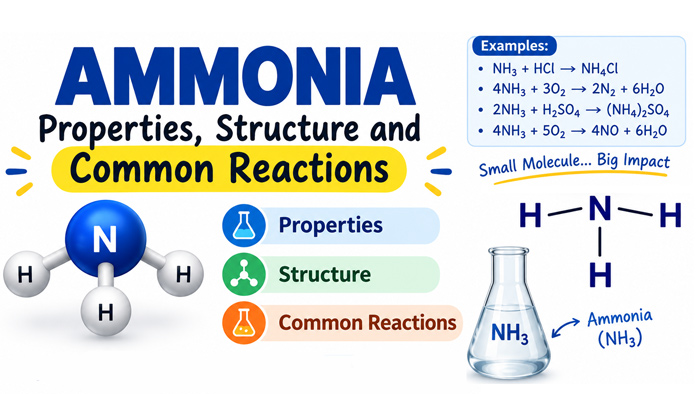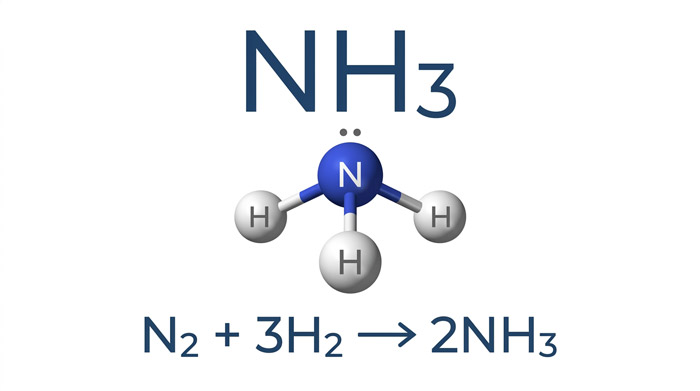
Ammonia, nitrogen and hydrogen in the compound, of the formula NH₃, is a colorless gas with a strong irritating odor. It is easily soluble in water, and 1 volume of water can dissolve 700 times the volume of ammonia under normal temperature and pressure.
The aqueous solution is also called ammonia. Cooling and pressurizing can turn into liquid. Liquid ammonia as a refrigerant. Ammonia is also an important raw material for the manufacture of nitric acid, fertilizers, and explosives.
Ammonia is very important to living things on earth. It is an important component of many foods and fertilizers. Ammonia is also a direct or indirect component of all drugs. Ammonia has a wide range of uses, and it also has corrosive and dangerous properties.
Because ammonia has a wide range of uses, ammonia is one of the most produced inorganic compounds in the world, and more than 80% of ammonia is used to make chemical fertilizers. Because ammonia can provide lone pair electrons, it is also a Lewis base.
Chemical properties
Reaction with oxygen
Combustion oxidation:
Ammonia can be burned in pure oxygen, and the product is a component in the air, which does not pollute the environment, so it has a certain application prospect:
Reaction with acid
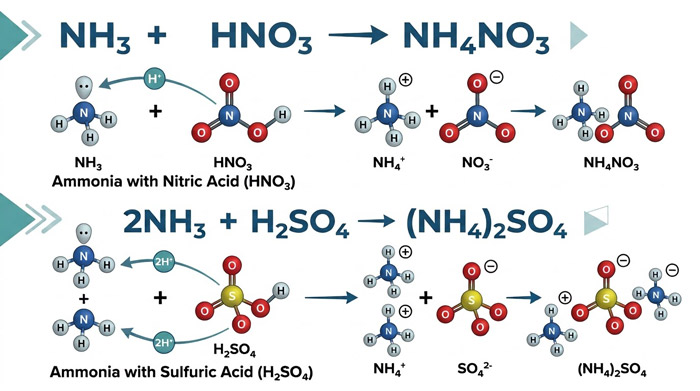
Ammonia can react with acids to form ammonium salts, such as:
Ammonia reacts with volatile acids (nitric acid, hydrochloric acid) to emit white smoke. These reactions can be used to check the presence of ammonia.
Reaction with metal
NH 3 can also complex with metal ions such as Ag, Cu, etc. to form complexes:
Reaction with water
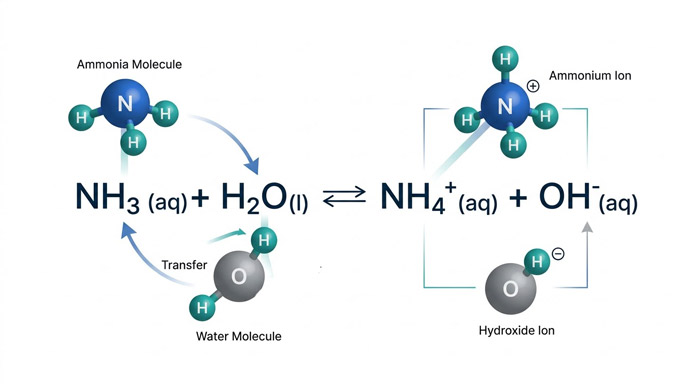
Ammonia is very easily soluble in water. When dissolved in water, it reacts with water to form ammonia monohydrate, commonly known as ammonia. The concentration of commercially available ammonia is 25% to 28%. Ammonia is weakly alkaline because of the ionization in water:
Redox reactions:
The catalytic oxidation of ammonia is an exothermic reaction and the product is NO, which is an important reaction for the industrial production of nitric acid, provided that the catalyst is at a high temperature.
Physical properties
| Property | Value / Description |
|---|---|
| Chemical Formula | NH₃ |
| Molar Mass | 17.03 g/mol |
| Appearance | Colorless gas |
| Odor | Pungent, sharp, irritating |
| Physical State at Room Temperature | Gas |
| Boiling Point | −33.34°C (−28.01°F) |
| Melting Point | −77.73°C (−107.91°F) |
| Density (Gas at STP) | 0.769 kg/m³ (0.769 g/L) |
| Density (Liquid at −33°C) | 0.682 g/cm³ |
| Vapor Density | 0.597 (air = 1) |
| Solubility in Water | Very high (31% w/w at 25°C; 47% at 0°C) |
| Solubility in Other Solvents | Soluble in ethanol, ether, chloroform |
| Critical Temperature | 132.4°C |
| Critical Pressure | 111.3 atm |
| Viscosity (Gas at 25°C) | 0.01007 mPa·s |
| Surface Tension (Liquid at −33°C) | 23.4 mN/m |
| Refractive Index (Liquid) | 1.325 |
| Dipole Moment | 1.47 D |
| Magnetic Susceptibility | Diamagnetic |
Ammonia (NH₃) is a fascinating compound with unique physical properties that make it indispensable in industry, agriculture, and everyday life. From its low boiling point and high water solubility to its pungent odor and polarity, every property has a practical significance.
Whether you’re a student preparing for exams or a professional working with ammonia, a clear understanding of its physical properties is essential for safe and effective use.