It is a Tri-hydric alcohols. Its formula is C3H8O3. By substituting one hydrogen atom containing one carbon atom in each molecule of propane by an -OH group, its structure formula is obtained.Its structure formula is the following.
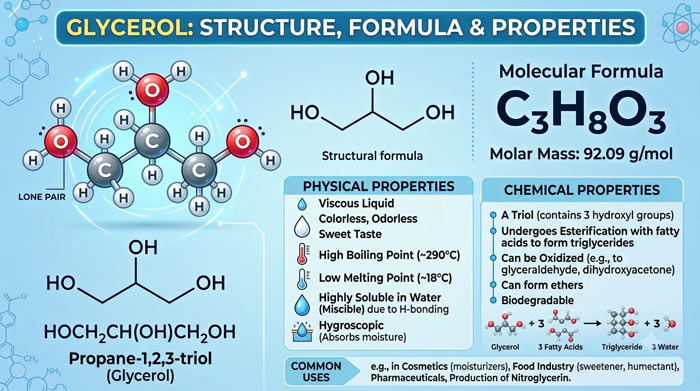
Its name is 1,2,3-propanetriol in the IUPAC method. In nature it is found as an ester with mono carboxylic acid present in oils and fats. The ester made with its high monocarboxylic acid is called Glycerides.Following are the formulas and names of some of the major Glycerides.
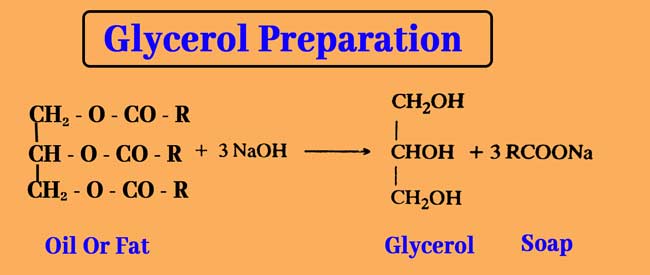
Glycerol Preparation :- Glycerol can be obtained from water decomposition of oils and fats in commercial quantities. Acidic water decomposition of oils and fats provides glycerol and high mono carboxylic acid. This reaction is used in the candle industry and the industrial manufacture of glycerol. The alkaline water decomposition of fats and fats produces sodium or potassium salt of glycerol and mono carboxylic acid.Those are called Soaps. This reaction is used in the soap industry and the industrial manufacture of glycerol.
Physical Properties of GlycerolGlycerol is a colorless, odorless, and thick liquid. It tastes sweet. Its boiling point is 290°C. But on heating it starts decomposing before this temperature. It is miscible in ethanol and water. But is immiscible in ether. On cooling it forms transparent crystal whose melting point is 180°C. It is heavier than water. Its relative density is 1.265.Chemical Properties of Glycerol. There are two types of Hydroxyl group in glycerol. Two primary and one secondary -OH group.Hence, it exhibits properties of both these types of hydroxyl group. Its main chemical reactions are as follows.
Glycerol: What Glycerol used for? | Preparation and Properties
Formic Acid: Preparation, Properties, Uses and Tests
Chloroform: Preparation, Properties and Uses
Diethyl Ether: How Diethyl Ether is prepared | Uses | Properties
Ethyl Alcohol: Are ethyl alcohol and ethanol the same?
Methanol(CH3OH): Properties, Preparation, uses and Tests
IUPAC Name : How to find the IUPAC name of compounds.
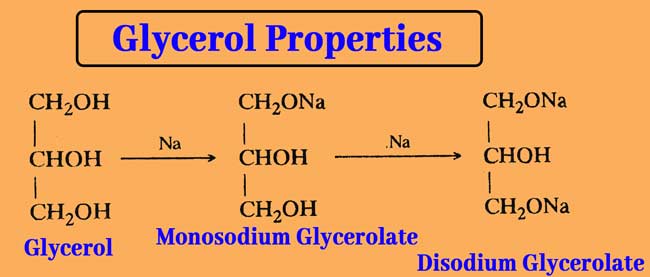
Reaction with Sodium or Potassium: Reaction with sodium or potassium replaces the hydrogen atoms of the primary -OH group. The reaction results in the formation of mono and di glycerolate. Na or K have no effect on the secondary alcohol group.
Physical Properties of GlycerolGlycerol is a colorless, odorless, and thick liquid. It tastes sweet. Its boiling point is 290°C. But on heating it starts decomposing before this temperature. It is miscible in ethanol and water. But is immiscible in ether. On cooling it forms transparent crystal whose melting point is 180°C. It is heavier than water. Its relative density is 1.265.Chemical Properties of Glycerol. There are two types of Hydroxyl group in glycerol. Two primary and one secondary -OH group.Hence, it exhibits properties of both these types of hydroxyl group. Its main chemical reactions are as follows.
Glycerol: What Glycerol used for? | Preparation and Properties
Formic Acid: Preparation, Properties, Uses and Tests
Chloroform: Preparation, Properties and Uses
Diethyl Ether: How Diethyl Ether is prepared | Uses | Properties
Ethyl Alcohol: Are ethyl alcohol and ethanol the same?
Methanol(CH3OH): Properties, Preparation, uses and Tests
IUPAC Name : How to find the IUPAC name of compounds.
Reaction with Sodium or Potassium: Reaction with sodium or potassium replaces the hydrogen atoms of the primary -OH group. The reaction results in the formation of mono and di glycerolate. Na or K have no effect on the secondary alcohol group.
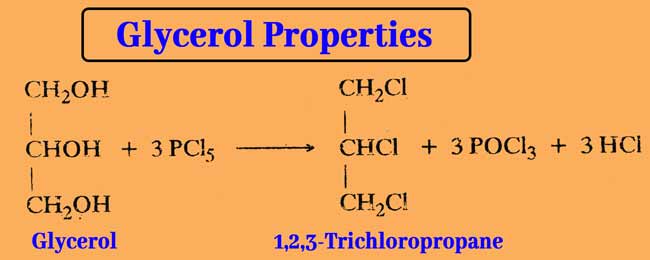
Reaction with phosphorus pentachloride: PCl5 reacts with glycerol and displaces three of its -OH group with chlorine atoms.
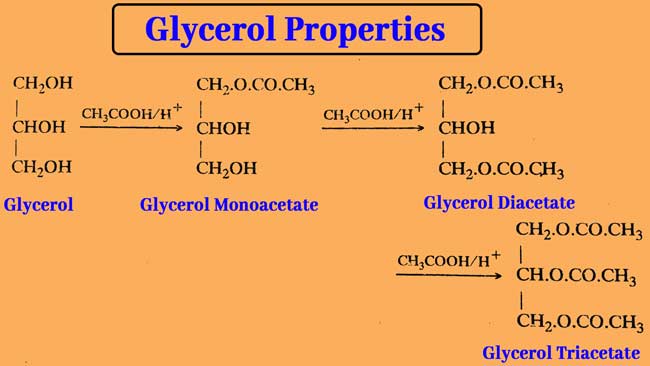
Reaction with mono oxalic acids: The reaction of glycerol with mono oxalic acids results in the formation of mono, di and tri ester.Example: Glycerol mono, di, and tri acetate are obtained with acetic acid respectively.
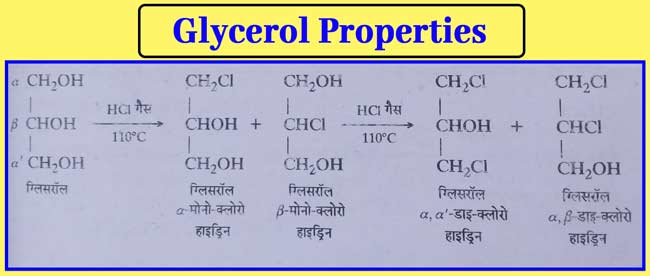
Reaction with HCl gas: α- and β- monochlorohydrin are formed when the theoretical amount of HCl gas is flowed in glycerol at 110°C heat. After this, α,α-di-chlorohydrin and α,β-di-chlorohydrin are formed when about 25% more than the theoretical amount of HCl gas flows at this temperature.
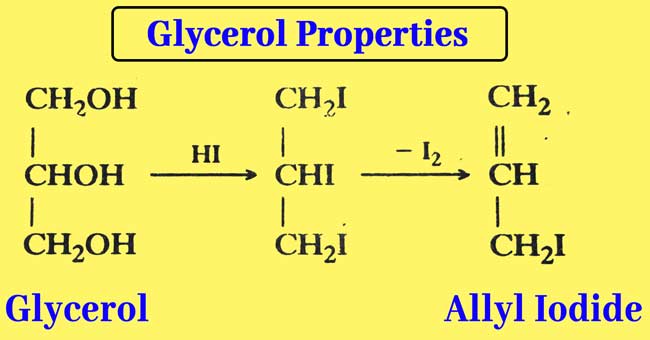
Reaction with Hydroiodic acid: Glycerol is reacted with a small amount of HI when allyl iodide is obtained.
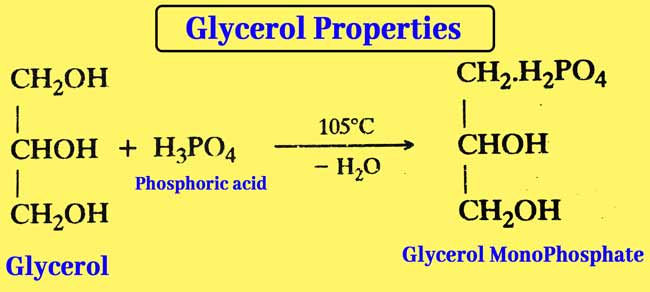
Reaction with phosphoric acid: The reaction of glycerol and phosphorus acid at 105°C results in Glycerol Mono Phosphate.
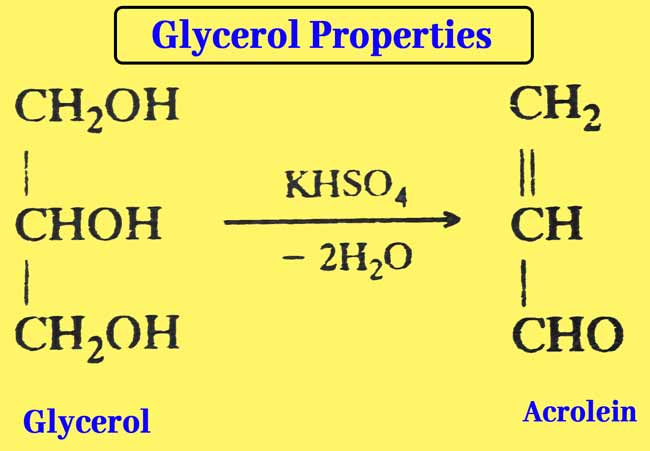
Dehydration: It is dehydrated when glycerol is heated with potassium hydrogen sulphate and the deodorant substance acrolein is obtained.
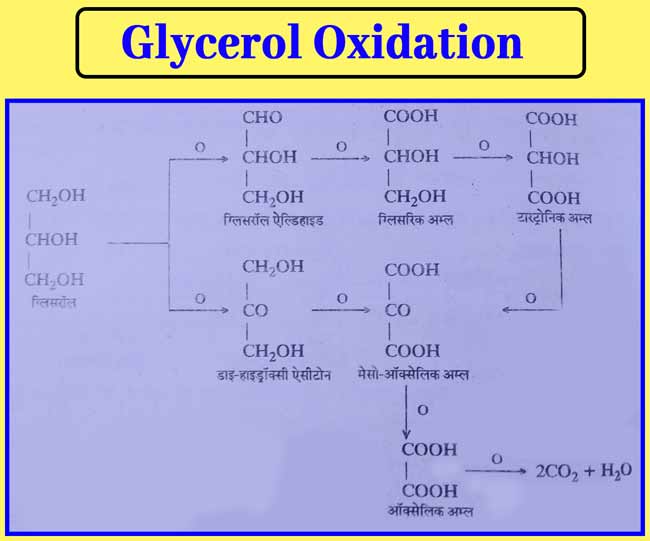
Oxidation: The oxidation of glycerol provides various substances depending on the nature of the oxidant.
Valency of Elements || How to Find Valency || What is the Valency of the atom?
Importance of Biomolecules in Life || What are the 4 main biomolecules?
Resonance effect or mesomeric effect || What is resonance effect with example?
Introduction of Inductive-Effect || How does Inductive Effect Work?
Glucose Structure: Physical and chemical properties, Glucose Chemical Reaction
Sodium Chloride Properties || Why Sodium Chloride is Soluble in Water
DDT full Form || What was DDT used for? || Is DDT harmful to humans?
Reproduction in Organisms
Chemicals in Medicine: Class 12
What is Urea || How to make Urea Fertilizer, || Urea uses
Example: Glyceric acid and tartronic acid are obtained upon oxidation by dilute HNO3.Glyceric acid is mainly obtained by oxidation by concentrated nitric acid.The mesoxalic acid is obtained mainly by oxidation by bismuth nitrate.Glycerol aldehyde and dihydroxyacetone are obtained upon oxidation by bromine water, sodium hypobromite or Fenton’s reagent (FeSO4 + H2O2).Formaldehyde and formic acid are obtained by oxidation by par iodic acid(HIO4).Oxalic acid water and CO2 are formed upon oxidation by KMnO4. The mixture of glycerol and KMnO4 is explosive. This mixture is used to make time bum.