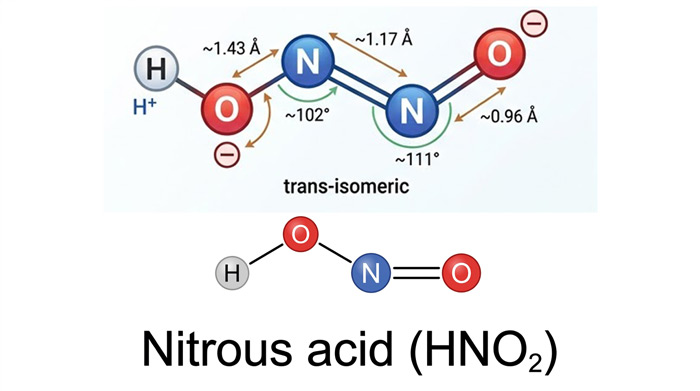
Nitrous acid is a temporary additive. It is not found in an independent state. Its aqueous solution can be obtained at low temperatures. It continues to decompose slowly even at room temperature.
Therefore, to be used in other reactions, first make its solution at low temperature and immediately after that.
Preparation of Nitrous Acid
Nitrous acid is obtained by the action of dilute HCl or H2SO4 on any nitrite.
KNO2 + HCl → KCl + HNO2
NaNO2 + HCl → NaCl + HNO2
KNO2 + H2SO4 → KHSO4 + HNO2
Nitrous acid is obtained when di-nitrogen tri-Oxide is dissolved in cold water.
N2O3 + H2O → 2HNO2
HNO2 is obtained by the action of barium nitrite and cold and dilute H2SO4.
Ba(NO2)2 + H2SO4 → BaSO4 + 2HNO2
This reaction is used in the laboratory method of making nitrous acid.
Barium sulfate is filtered and separated and remains in HNO2 solution.
Physical Properties
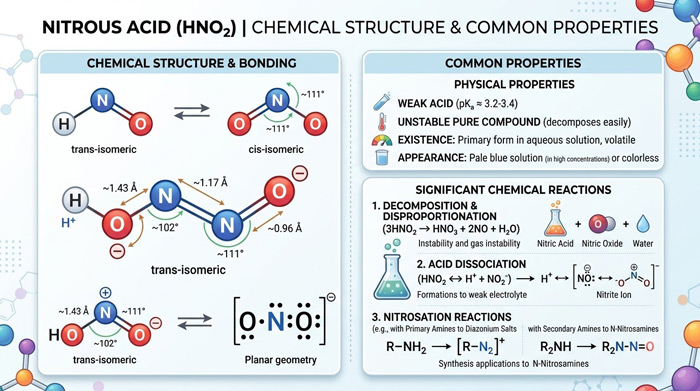
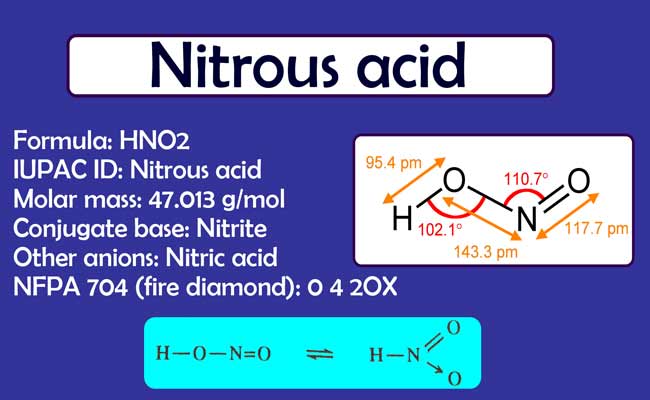
Nitrous acid (HNO₂) is a weak, monobasic acid that exists only in aqueous solution or as a pale blue solid; it cannot be isolated as a pure gas because it is highly unstable. It has a molar mass of about 47 g/mol. The pure compound is a pale blue solid with a melting point of approximately 42°C, but it decomposes rapidly even at room temperature.
In aqueous solution, nitrous acid is colorless to pale blue and has a characteristic acidic odor. It is highly soluble in water and readily dissolves in cold water to form a weakly acidic solution (pKa ≈ 3.3 at 25°C).
Nitrous acid is unstable and decomposes slowly at room temperature, and more rapidly on heating, producing nitric oxide (NO), nitrogen dioxide (NO₂), and water.
Due to its instability, it is always prepared fresh in situ and used immediately in reactions such as diazotization and nitrosation.
Chemical Properties
Decomposition: Anhydrous nitrous acid is temporary and decomposes into NO, NO2 and H2O.
2HNO2 ⇌ NO + NO2 + H2O
It slowly decomposes in aqueous solution –
3HNO2 → 2NO + H2O + HNO3
In aqueous solution, its decomposition speed is higher at low temperature and high at high temperature.
Acidic Properties: Nitrous acid is a weak acid, it reacts with alkalis to form salts called nitrous salts.
HNO2 + NaOH → NaNO2 + H2O
Oxidizing Properties: In the presence of catabolizes, it decomposes and produces nascent oxygen.
For this reason it is a strong oxidizer.
2HNO2 → 2NO + H2O + O
This iodine is released from any iodide salts in the presence of dilute H2SO4.
2KI + H2SO4 + 2HNO2 → 2NO + I2 + K2SO4 + 2H2O
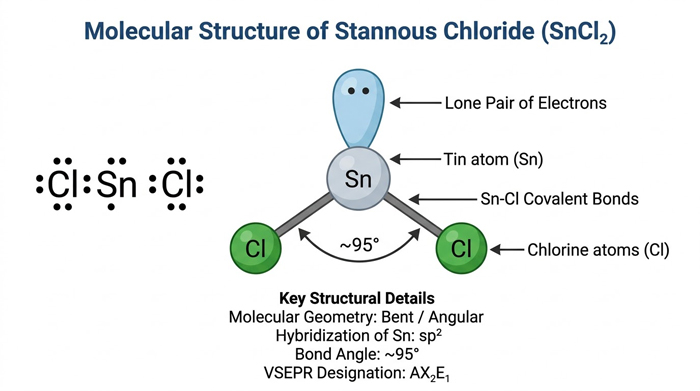
This oxidizes stannous chloride to stannic chloride.
SnCl2 + 2HNO2 + 2HCl → SnCl4 + 2H2O + 2NO
Safety and Handling
Nitrous acid is toxic and corrosive. It causes severe skin burns and eye damage. Inhalation can irritate the respiratory tract and cause central nervous system effects including headache, dizziness, and nausea.
Safety Precautions:
Always prepare nitrous acid fresh in situ and use immediately
Work in a well-ventilated area or fume hood
Wear protective equipment including gloves, goggles, and lab coat
Avoid contact with oxidizing agents, organic materials, and combustible substances
Store nitrite salts separately from acids and reducing agents
Conclusion
Nitrous acid (HNO₂) is a fascinating yet challenging compound. Its instability makes it impossible to store, yet its reactivity makes it invaluable in organic synthesis. From creating the vibrant colors of azo dyes to enabling pharmaceutical synthesis, nitrous acid plays a quiet but essential role in modern chemistry. Understanding its preparation, properties, and safe handling is crucial for anyone working with this remarkable chemical.